
Home Appliance
Appliances compete on cost per tonne and first-pass forming yield. The choice usually sits between 201 / 304 / 430, and what separates them is deep-drawing behaviour and surface class rather than corrosion resistance.
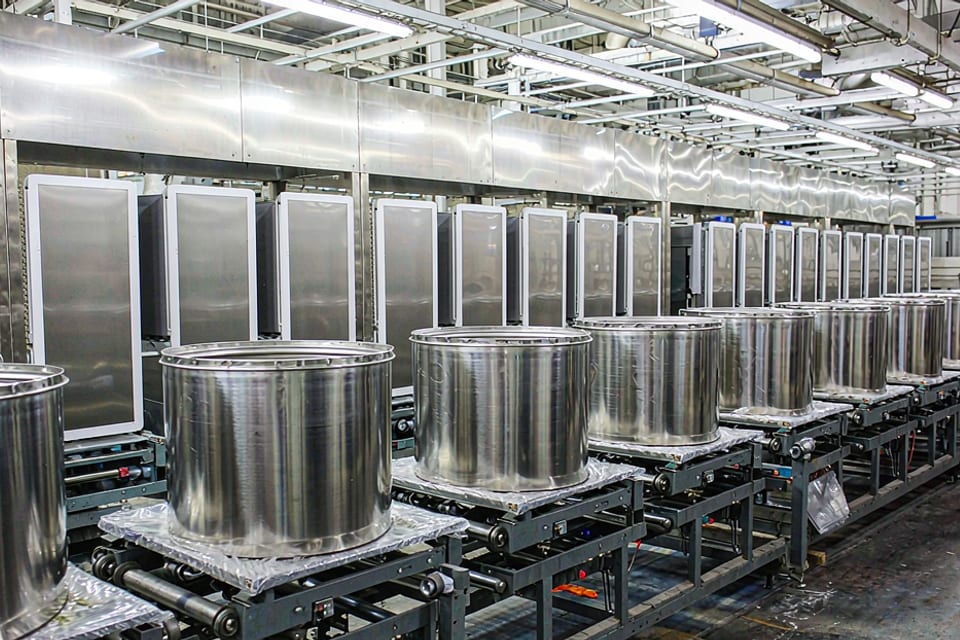
Typical parts and material selection
| Part | Grade | Surface / size | Watch out for |
|---|---|---|---|
| Refrigerator door / side panel | 304 / 430 | 2B / brushed / embossed, 0.4–0.8 mm | Surface class, bend lines |
| Washing machine drum | 304 / 201 | 2B, 0.5–1.0 mm | Deep-drawing r-value, welding |
| Sink / dishwasher liner | 304 | 2B / embossed, 0.6–1.2 mm | Drawing cracks, scratches |
| Cookware | 304 / 201 / 430 | 2B / BA, 0.4–1.0 mm | Magnetic response (430 for IH) |
| Hob panel | 304 / 430 | HL / 8K, 0.6–1.0 mm | Fingerprint and heat resistance |
Three real constraints in this industry
First-pass yield is set by r-value
Deep-drawn parts such as drums and sinks need high r and low Δr. The same grade from a different rolling schedule differs a lot — run a drawing trial on the actual batch.
Surface class must be agreed by application
Appliance panels tolerate no pitting, scratches or roll marks. Specify the surface class (e.g. 2B judged to ASTM A480) and keep the protective film on.
201 can replace 304 only in dry areas
201 is manganese-bearing and clearly less corrosion resistant. It is fine for dry interior parts, but in contact with water or detergent it pits — the rework cost far exceeds the saving.
Related products
Need a quote or technical support?
Send us the part, grade, size, quantity and destination port — we reply with FOB / CIF within 24 hours.