
B16 · HVAC & Refrigeration
Stainless Steel Sheets for HVAC&R: 316L/304 Selection & 7 Part Lists
In HVAC&R, we’ve compiled seven stainless steel parts commonly used: 316L / 304 / 2205, with thickness ranging from 0.4–25 mm.
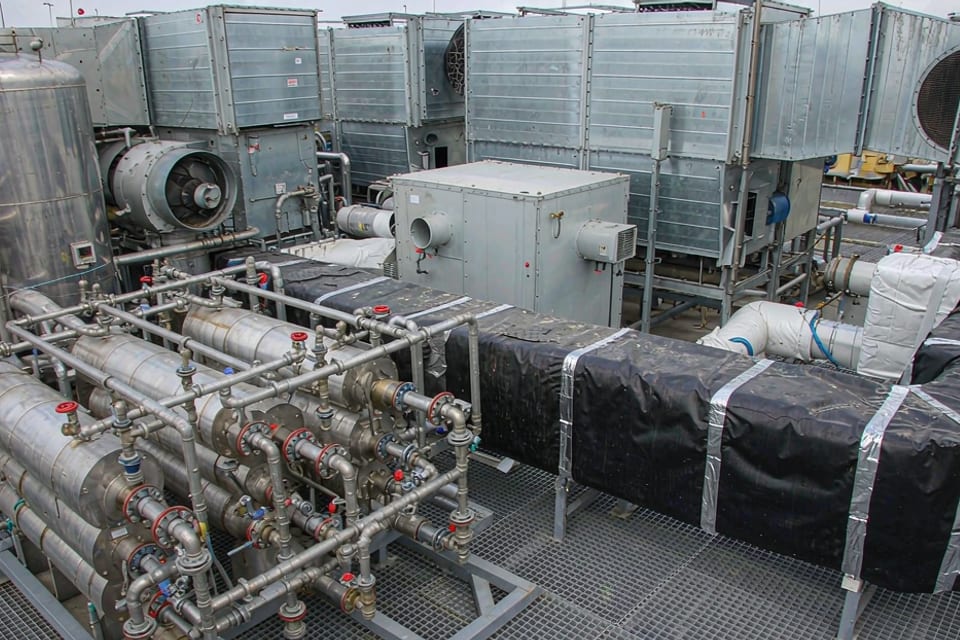
List of parts and material recommendations
| Part / Component | Recommended grade | Size / Thickness | Surface | Failure Modes | Standards |
|---|---|---|---|---|---|
| Cold Chiller/Radiant Exchanger Tubes | 316L(Cl⁻≤50ppm)/2205(high chloride) | Tube φ9.52–25mm; Wall Thickness 0.5–1.0mm | Bright/Acid Pickled | Cl⁻ Pitting: Cl⁻ > 50ppm increases risk; 100ppm+ ClO₂ has led to 316L failures; Concentration accelerates at crevices | GB/T 151; ASTM A249; Cl⁻ Limit General Reference |
| Heat exchanger plates | 304/316L | 0.4–0.8mm | 2B/embossed | Cl⁻ pitting+filming corrosion+seal aging | NB/T 47004;GB/T 3280 |
| Cooling tower fillings/supports/nut fittings/splash pans | 304/316L | 2–6mm;M8–M16 | 2B/dielectric treatment | Wet heat+cycled water Cl⁻ concentration+microbial corrosion | GB/T 3280;GB/T 3098.6 |
| Refrigerant lines/storage tanks/fittings | 304/316L | 1–5mm | 2B/acid washing | CFC + oil +trace moisture → organic acid corrosion | GB/T 3280;GB/T 9237 |
| Condenser/ evaporator tubes / connecting pipes | 304/316L | φ7-16mm SeamlessSteel pipes | Bright/Scaled | Condensate + Coastal Cl⁻ + Vibration Fatigue | GB/T 3280;GB/T 23137 |
| Radiant Floor Distribution/Fittings | 304/316L | DN20–DN40 | Passivation / Acid Washing | Hot Water + Cl⁻ + Oxygen → Pitting; Corrosion in Buried Gaps | GB/T 3280;CJ/T 228 |
| Cold storage/Refrigeration panels/Rack/Framing | 304/430 | 0.5–2.0mm | 2B/Laminated | High humidity at low temperature + Food contact + Cleaning agent | GB/T 3280;GB 4806.9 |
Inside areStandard configuration.The same part may switch from 304 to 316L or 2205 depending on the medium, temperature, and welding method —— Explain the usage conditions; it's easier than specifying grades directly.
Key points in material selection
- The most common grade is 316L (6), 304 (6), and 2205 (1) —— The numbers in parentheses indicate the number of parts involved, which can serve as a starting point for quoting and inventorying.
- Common Corrosion Sources: Chloride and Salts (5/7 hits) - Pitting, Crevice Corrosion.
- High Temperature Adds Hot Fatigue and Oxidation; Consider 310S / Heat-Treated Castings (2/7 hits).
- Thickness Range 0.4–25 mm: Thin Sheets Are Formed Parts (Consider Bending Rebound and Deep Drawing Cracks); Thick Sheets Are Welded Structures (Consider Heat Input and Sensitization).
Common Issues
What stainless steel is used most for HVAC&R?
By total number of occurrences, 316L (6), 304 (6), and 2205 (1) are the top three. Specific parts still depend on the medium and temperature.
Which part is the easiest to fail?
According to failure descriptions, typical examples include "tube bundles in cold water chillers/heat pumps": Cl⁻ stress corrosion cracking: risk increases with Cl⁻ > 50 ppm; cases of 316L failing at 100 ppm + ClO₂; accelerated concentration at crevices; recommended grade 316L (Cl⁻ ≤ 50 ppm)/2205 (high chloride), size φ9.52–25 mm, wall thickness 0.5–1.0 mm. For these conditions, it's recommended to specify medium concentration, temperature, and cleaning methods in the design phase.
What thickness should I select?
Thickness range in the list is 0.4–25 mm. For thin plates, consider bending and surface finish; for thick plates, welding and structural strength. Values may vary by manufacturer for the same part based on your drawing or operating conditions. Recheck as needed.
Related Materials and Adjacent Industries
2205Materials and Specifications316LMaterial & Specifications304Material & Specifications430Material & SpecificationsInfrastructure & ConstructionConstruction & InfrastructureElectricity and heat production and supply (including FGD desulfurization)Power & Energy (incl. FGD)Gas production and supply industryGas Supply
Applications7
Thickness0.4–25mm