
B15 · Houseware & Kitchenware
Stainless Steel Sheets for Kitchenware: 304/201 Selection and 4 Part Lists
In Our Kitchenware, We Organized 4 Parts Using Stainless Steel: Commonly Used 304 / 201 / 316, Thickness from 0.3–5 mm.
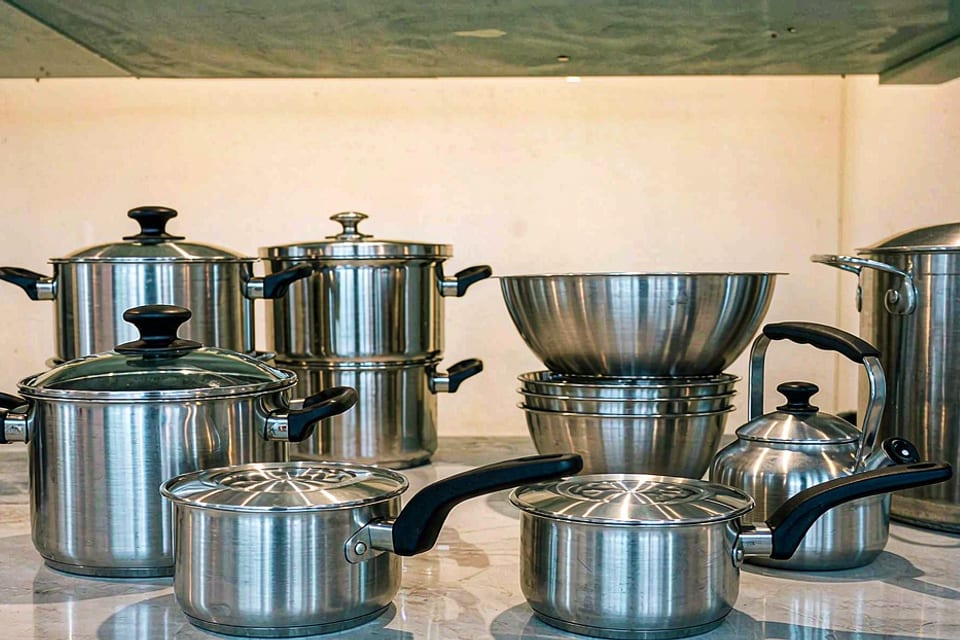
Four parts and material list
| Part / Component | Recommended grade | Size / Thickness | Surface | Main failure modes | Reference standards |
|---|---|---|---|---|---|
| Cookware/Teacups/Milk jugs inner walls | 304/316/201 | 0.3–1.2mm | 2B/Dial/electro-polishing | Food contact+acid+washing+dry burning discoloration | GB/T 3280; GB 4806.9 |
| Cutting tools/Slicing blades | 420/440 | 1–5mm | Quenched/polished | Edge wear+chipping+food acid corrosion | GB/T 1220; GB 4806.9 |
| Sink countertops water shields | 304/201 | 0.8–3.0mm | 2B satin embossed | Moisture detergent for food contact | GB/T 3280; GB 4806.9 |
| Hammocks | 304/201 | 0.5–2.0mm | Mirror satin gold plating | Moisture soap solution scale hand sweat | GB/T 3280 |
Below isStandard configurationSpecify material based on usage conditions.
Key considerations
- Most common grades in this industry are 304 (3), 201 (3), and 316 (1) — parentheses indicate the number of affected areas, useful for quoting and material procurement.
- In acidic media, 316L is just a starting point; higher concentrations or temperatures may require 904L / duplex (2/4).
- Min. thickness 0.3–5 mm: Thin plates are mostly formed parts (consider bending rebound and deep drawing cracking), thick plates are mostly welded structures (consider heat input and sensitization).
Common questions
Which stainless steel is used most in home and daily use, as well as kitchenware?
Total pages statistics show that the top 4 parts are 304 (3 items), 201 (3 items), and 316 (1 item). Specific to a part still depends on the medium and temperature, for example, stainless steel countertops require switching from 304 to 316L when exposed to saltwater.
What's the most vulnerable part?
By failure description, typical is "inner lining of pots/cups/thermos": Food contact + salt / acid + cleaning + blackening from dry burning. Recommended grades 304/316/201, thickness range 0.3–1.2 mm. For this condition, specify medium concentration, temperature, and cleaning method in the design phase.
What thickness should I choose?
Thickness ranges from 0.3–5 mm. Thin plates consider forming and surface quality, thick plates consider welding strength and structural integrity; different manufacturers may have varying values for the same part based on your drawings or operating conditions. Review these factors as needed.
Related materials and adjacent industries
Delivery case for similar operating conditions
Kitchenware and cookware manufacturing
Stainless steel rounds · 0.4–3.0 mm
304 / 201 stainless steel rounds, deep drawn grade, 2B and BA finishes, thickness 0.4–3.0 mm, custom-made by diameter and weight.
Applications4
Thickness0.3–5mm