
B05 · Wastewater & Environmental
Environmental Protection Stainless Steel Plates: 316/304 Selection and 11 Item List
In Environmental Protection, We Have Compiled 11 Parts Using Stainless Steel: Commonly Used 316 / 304 / 316L, Thickness Ranging from 2–200 mm.
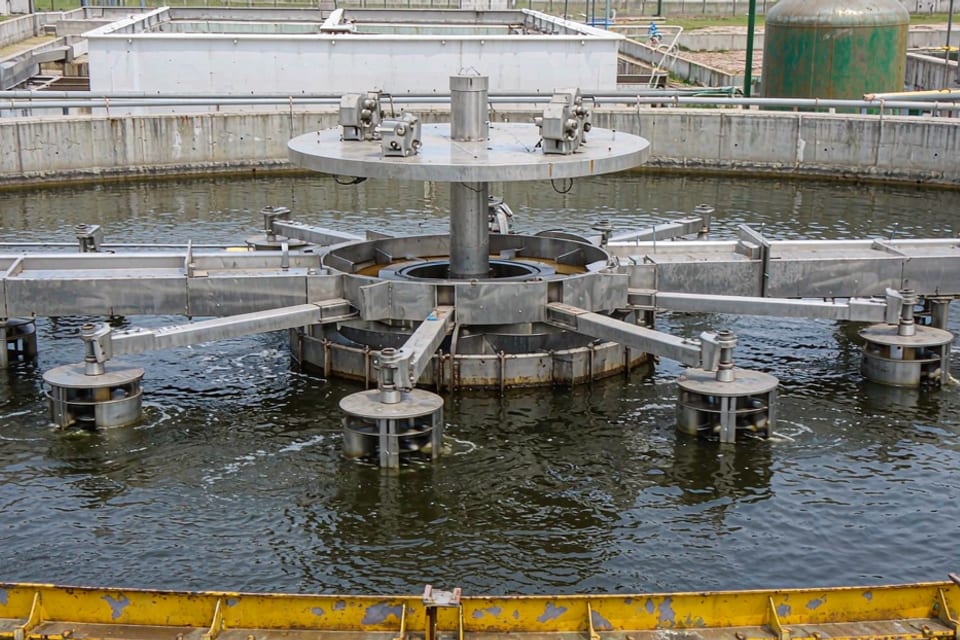
11 Parts and Material List
| Part / Component | Recommended Grade | Specifications / Thickness | Surface | Main failure modes | Reference standards |
|---|---|---|---|---|---|
| GrooveGrubber | 304 | Tooth 3-8mm | Working surface | Sandstone wear + sewage corrosion | GB/T 3280;CJ/T 3048 |
| Grate frame/Grit bars/Traction chain | 304 | Steel plate/tube 5-12mm | 2B/Annealed | Moisture+Hydrogen Sulfide Corrosion+Wear | GB/T 3280 |
| Inflow Fine Mesh Grille Submersible Plates/Shield | 316 (Submersible Main Components) | 2.0–6.0mm | 2B | Long-term underwater immersion + Cl⁻ pitting | GB/T 3280 |
| Centrifugal sludge scraper shaft | 420 (Axles)/316LRound pipe | Diameter 50–200mm, Wall thickness 5–12mm | Processed surface/2B | Overload torque + corrosion fatigue | GB/T 1220;GB/T 3280 |
| Blade/Pump Shell (FlowPieces) | 316 | Forgings/plates 2-10mm | 2B/Face | Sludge erosion+corrosion | GB/T 3280;GB/T 2100 |
| Pump uprights/trusses/feces collectors/suction pipes | 316/316L | 3–12mm | 2B | Sludge + Wastewater + Hydrogen Sulfide Corrosion | GB/T 3280;ASTM 316L |
| Concentrating Machine Scraper Arm/Scraper/Rod/Water Discharge Flange | 316 | 2–8mm | 2B | Sludge Erosion + Corrosion | GB/T 3280 |
| Rod/Support/Hydraulically Non-Flow Chain | 304 | 2–8mm | 2B | Moist Atmospheric Corrosion | GB/T 3280 |
| Micro Porosity Aeration Fasteners | 316 | M6–M12 | Passivatie | Wastewater Treatment, Aeration Oxidation, Crevice Corrosion Prevention | GB/T 3098.6 |
| Add drug delivery tank/piping | 316L | 2–6mm | 2B | Chlorine dioxide/Ozone/sulfuric acid corrosion | GB/T 3280 |
| High-chloride wastewater pipe/exchanger/membrane shell | 2205/2507 | 2–20mm | 2B/acid wash | High-chloride ion pitting+stress corrosion cracking | ASTM A240;GB/T 3280 |
See table forStandard configuration. Same part may use 304, 316L, or 2205 depending on the medium, temperature, and welding method—explain usage conditions instead of specifying grades.
Material Selection Tips
- Most common grades in this industry are 316 (5), 304 (3), and 316L (3) —— numbers in parentheses indicate the number of parts involved, as a starting point for quoting and material procurement.
- Corrosion from chloride ions and salts is most common (pitting, crevice corrosion) (3/11 hits).
- Consider hardness for wear components (edges, liners, conveyors) beyond just corrosion resistance (2/11 hits).
- Thickness range 2–200 mm: Thin plates are mostly formed parts (considering bend rebound and deep drawing cracking), thick plates are mostly welded structures (considering heat input and sensitization).
Common Issues
Wastewater treatment and recycling / Which stainless steel is used most for environmental purposes?
Out of the total 11 parts, 316 appears most frequently (5 times), followed by 304 (3 times) and 316L (3 times). Specific to a part still depends on the medium and temperature, e.g., a stainless steel countertop would need to switch from 304 to 316L if it contacts saltwater.
What parts are the easiest to fail?
By failure description, typical is "high chloride wastewater pipe/heat exchanger/membrane shell": pitting and stress corrosion cracking; recommended grade 2205/2507, size 2–20mm. For this type of condition, it's recommended to specify the medium concentration, temperature, and cleaning method during design.
How thick should the thickness usually be?
Thickness range in the list is 2–200 mm. For thin plates, consider bending and surface finish; for thick plates, welding and structural strength. Values may vary by manufacturer for the same location, review your drawing or operating conditions.
Related materials and adjacent industries
Vergelykbare werkingsomstandigheden
Chemie- en Omgewingsequipment
Stainless steek middeldeikte 3–60 mm
316L / 2205 steek middeldeikte en hot rolled rol, dikte 3–60 mm, vir stokken, wisselverwarming en FGD-toepassing, verskynbaar vir derdepartyske herverwerking.
Applications11